The model
Context
Creative testing usually happens after the money is spent. You ship two variants, wait for the data, and by the time the winner is clear a large share of the budget has already gone to the loser.
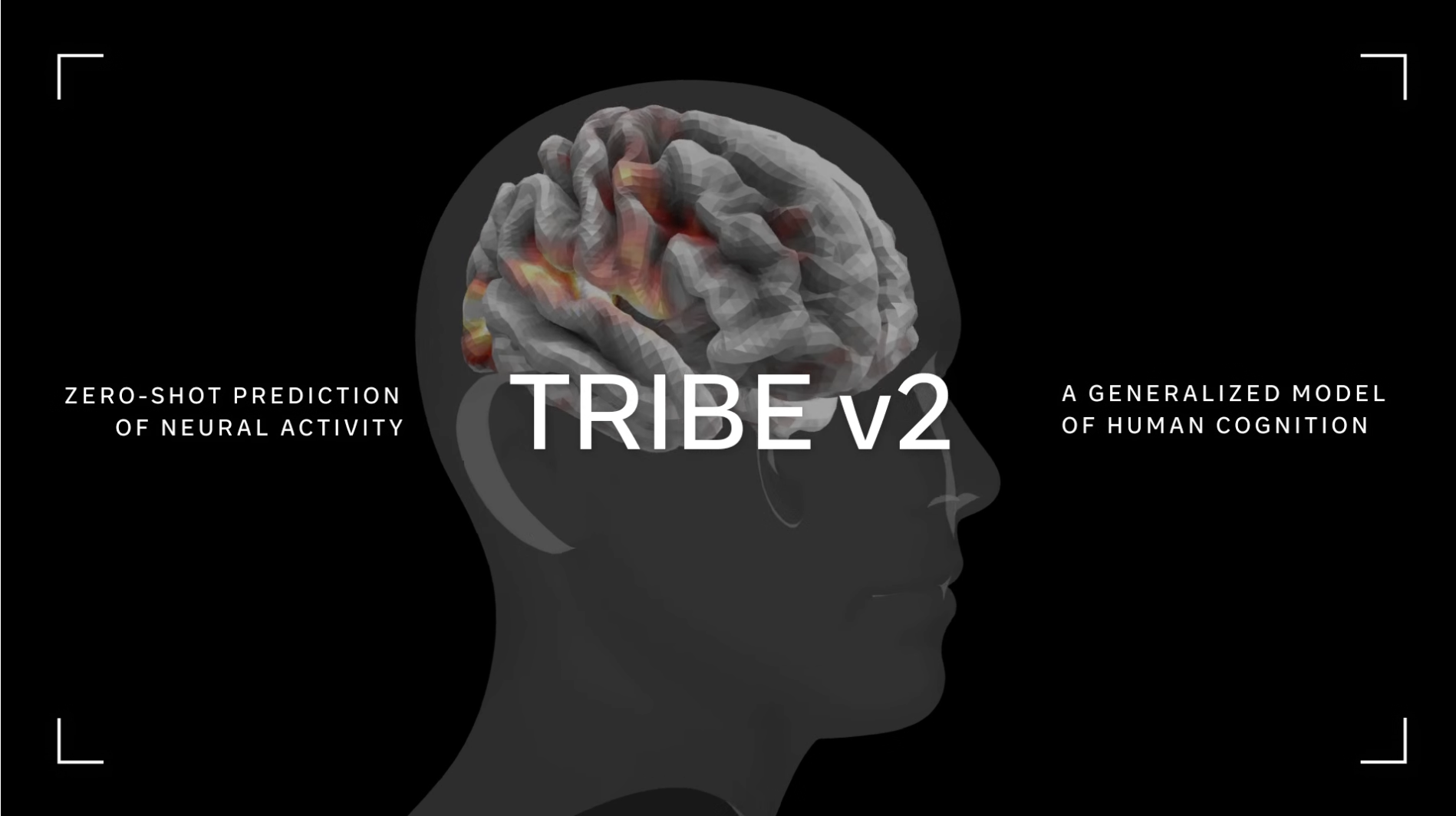
Meta FAIR released TRIBE v2, a multimodal brain-encoding model that predicts fMRI response across roughly 20,000 cortical vertices from video, audio or text. I wanted to know whether it could act as a fast tiebreaker between two creatives.
What I built
A Gradio web app running on a Colab GPU with four tabs — video, image, audio and text — each with a scorecard weighted for that modality. A video is judged mostly on hook strength and attention capture; a text variant mostly on language activation.
- V1Primary visual cortex — is the frame grabbing the eye in the first five seconds
- FusiformVentral visual stream — are the brand and product actually being recognised
- STGAuditory cortex — is the music, voiceover and sound design landing
- DMNDefault mode network — deactivation means the viewer is locked in, not mind-wandering
- LanguageBroca’s area and middle temporal — is the message parsed for meaning
- TPJTemporo-parietal junction — do the senses integrate into one coherent experience
Version 8
The first version gave a winner and a scorecard. That was not enough to act on, so v8 added the parts that make a result usable:
- CoherenceCorrelation between the two ads’ brain responses — are you testing a real difference or a tiny variation
- PeaksTime-locked analysis showing the second at which each network peaks, often not where the hook was intended
- RecallA brand-recall proxy measuring whether fusiform activation holds into the back third of the clip
- Confidence95% bootstrap intervals — if the intervals overlap, that winner is probably noise
- HistoryEvery run logs to CSV, with trend charts across all tests
Honest limits
These are neuro-proxies, not validated click-through predictors. TRIBE models the average healthy adult brain, not a specific customer segment. Image, audio and text are wrapped into synthetic video for the model to process, which makes them weaker signal than true video.
I use it as a tiebreaker between creative options, never as the sole decision — and the workflow is to compare predicted rank against real campaign data after seven days, so the tool earns trust rather than assuming it.
Licensing: TRIBE v2 is released under CC BY-NC 4.0 — non-commercial use only. This is internal research tooling, presented here as R&D, not as a commercial service.